04/24/26
Temperature Control as the Key to Optimum Cut Quality
In manufacturing, cut quality is frequently defined primarily by material properties. The substrate, its structure and surface characteristics undoubtedly form the foundation for a clean cut result. Yet even with consistent material properties, results in practice can vary - pointing to a further, often underestimated influencing factor: deliberate temperature control during the cutting process.
Over the past few months, we at SOMATEC have conducted extensive series of tests, gaining insights that have fundamentally changed the way we look at the cutting process.
Why the Material Alone Is Not Enough
Of course, any assessment of cut quality begins with the material. Film thickness, composition and mechanical properties all determine how a material behaves under the blade.In practice, however, we repeatedly encounter situations where two identical materials, cut with the same blade on the same machine, produce different results. Fraying, heat fusion marks and unclean edges appear, even though neither the material nor the tooling has changed. The critical variable we identified is temperature control. Even small deviations in temperature settings can significantly affect the cut result. To make this relationship tangible, we investigated it systematically in our in-house laboratory.
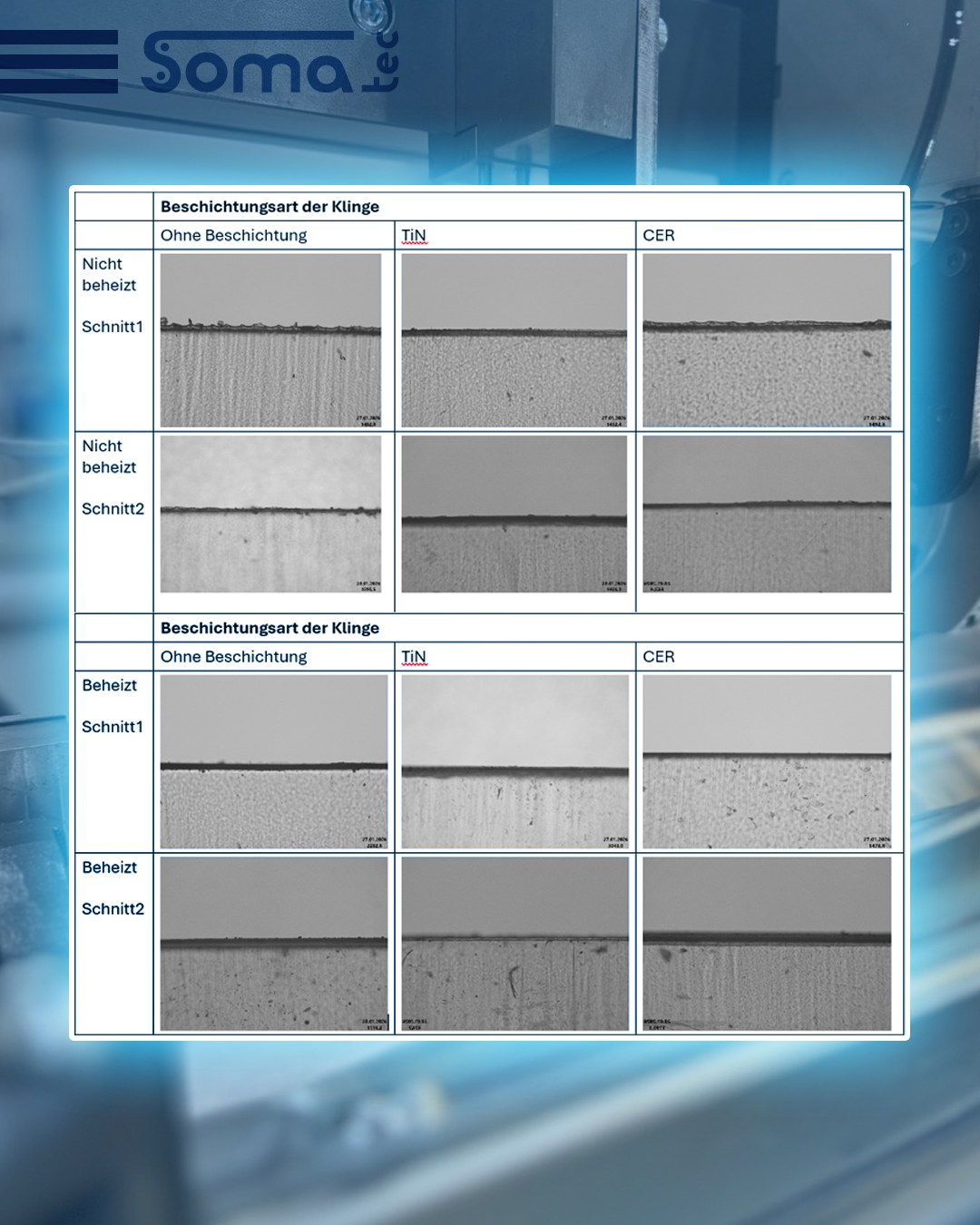
Heated vs. Non-Heated, Coated vs. Uncoated
To examine the influence of tempering in a structured way, we compared different configurations in our laboratory: heated and non-heated blade holders, each with uncoated blades, TiN-coated blades and CER-coated blades.The results under the microscope are clear. The heated blade holders deliver a cleaner cut profile with smoother edges and fewer irregularities across all coating variants. The difference is particularly striking with uncoated blades, which produce noticeable fraying without temperature control, yet deliver considerably better results when tempered.
The combination of tempering and coating further amplifies the effect. TiN- and CER-coated blades used in conjunction with a heated blade holder achieve the best overall result. Under the microscope, the edges are virtually free of defects.
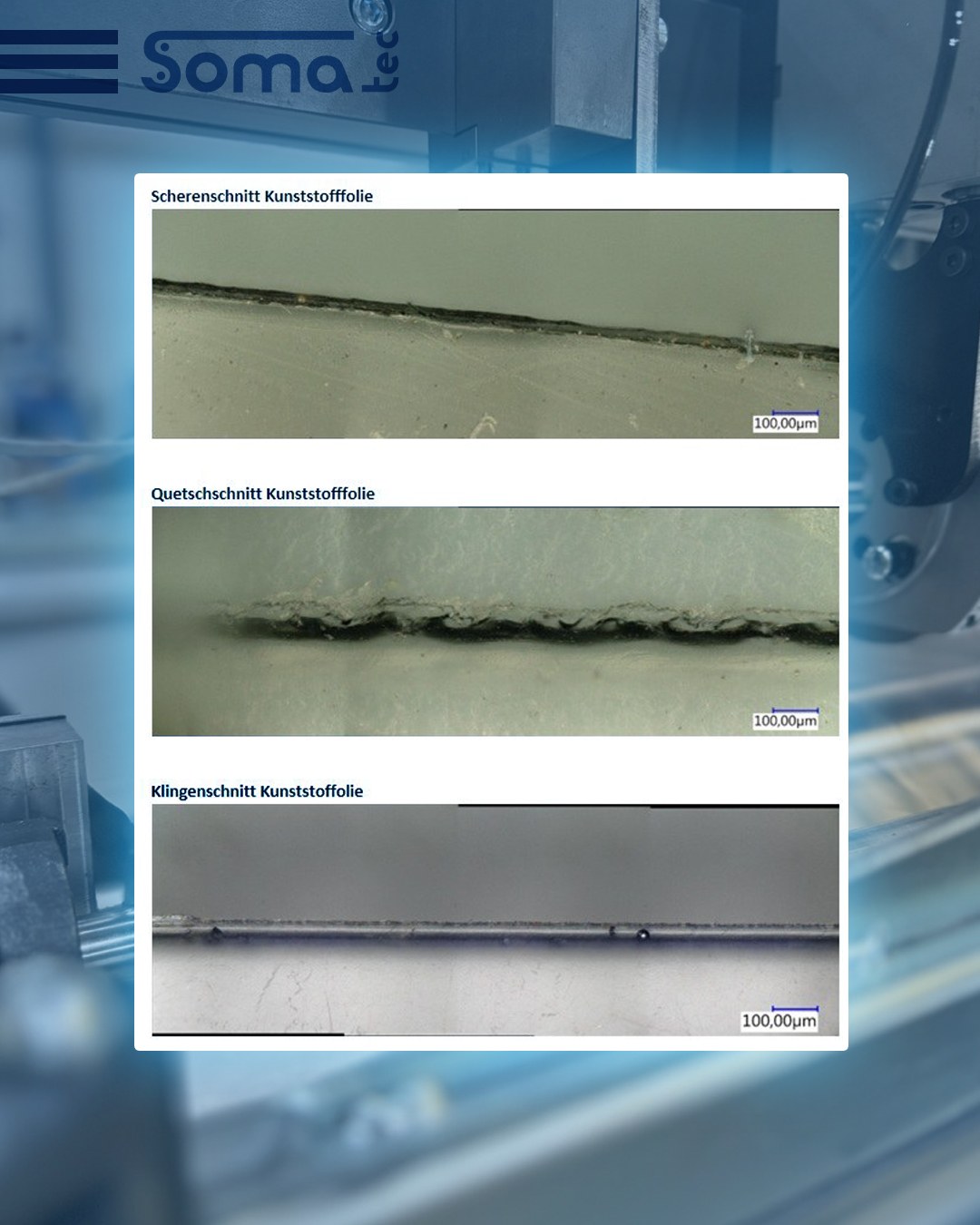
Cutting Methods Compared
Beyond temperature control, the cutting method itself also plays a decisive role. The shear cut does achieve separation, but shows clear deformation and material burr under the microscope. Even less consistent is the crush cut, in which the material is pressed against a counter roller until it tears - resulting in coarse edge structures and high levels of dust generation.Blade cutting with the tempered ENGEL blade holder delivers a fundamentally different outcome. The blade separates the material in a controlled manner with minimal mechanical stress. Combined with the correct temperature setting, the resulting cut profile is clearly superior to both other methods.
In our laboratory, we can analyse the cut in detail and work with our customers to determine the right parameters - from blade coating and temperature setting through to fine-tuning for a specific film formulation.
Cut Quality Is Not a Matter of Chance. At SOMATEC, We Make It Measurable.
The quality of a cut is not the result of a single parameter. It is the interplay of material expertise, the right cutting method and precise temperature control. Those who understand and align these three factors will achieve results that speak for themselves - even under the microscope.If you would like to take your cut quality to the next level, get in touch with us. Together, we will find the optimum solution for your material and your application. Simply reach out to us!